
Inside the on-site assessment
Mold needs water. We find the water first.
Three methods, used together on every visit: moisture detection, moisture mapping, and thermal imaging. Here is what each one does and why it matters to your results.
- Nothing opened or cut
- Florida licensed mold assessor
- Every finding in your written report
Verified twice
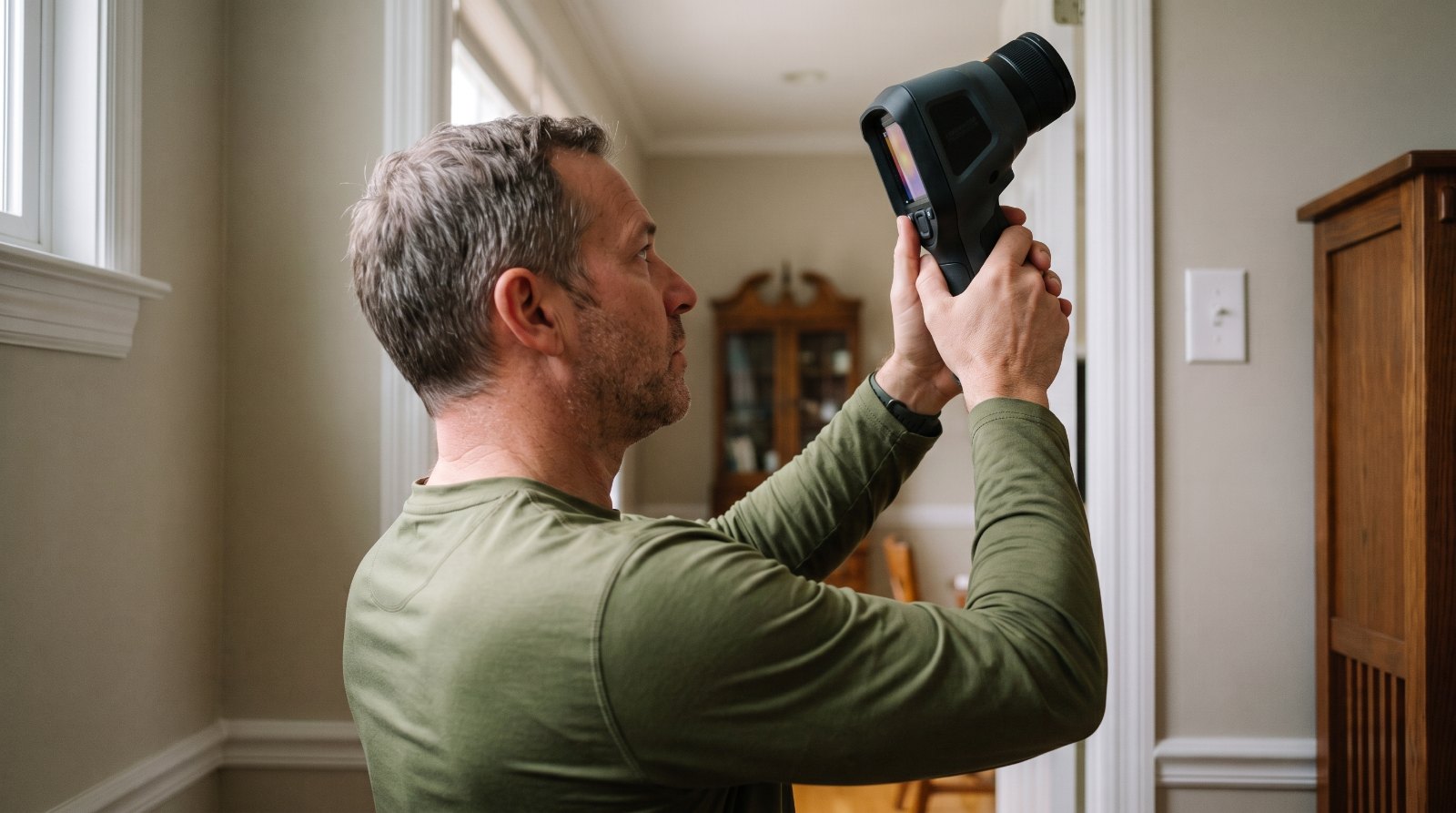
The camera finds it. The meter confirms it.
Why it matters
A lab result is a snapshot. Moisture is the story.
Mold does not grow without moisture. Air sampling tells you what is in the air today. These three methods tell you where the water is coming from, how far it has spread, and whether it is still active.
01
Moisture Detection. Is it wet right now?
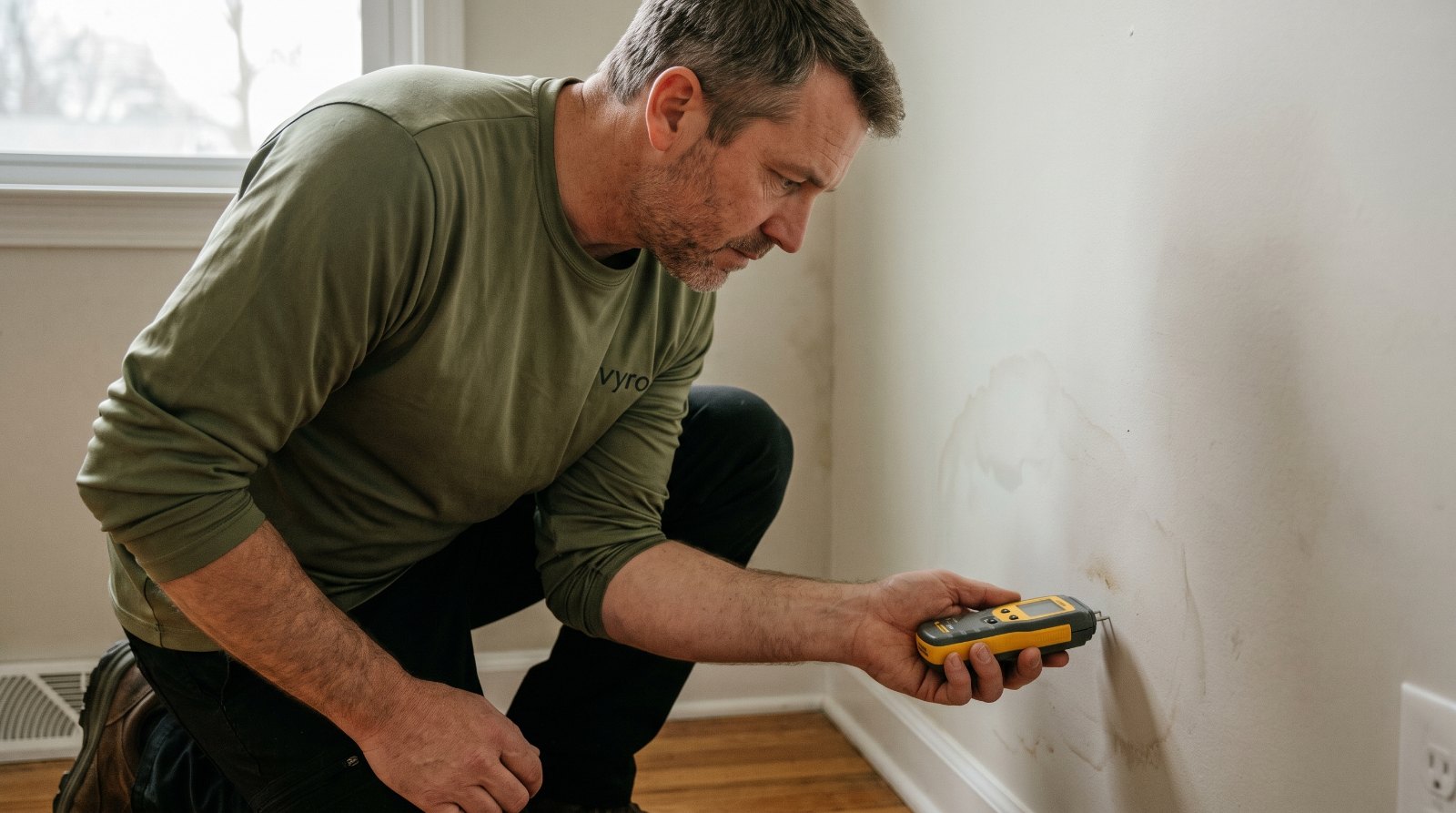
Moisture detection measures the moisture inside your walls, floors, and trim, plus the humidity in the air around them. A stain is not the boundary of a problem: materials can read wet with nothing to see, and an old stain can be bone dry.
How we do it
01
Scan
A pinless meter sweeps walls, ceilings, and floors. Nothing is opened or cut.
02
Confirm
Pin readings quantify anything the sweep flags, against a dry standard from the same home.
03
Log the air
Humidity and temperature, room by room and at the air handler.
Why it matters
Active or historical. A wet reading means water is still getting in, and no remediation holds until it stops.
Leak, condensation, or humidity. Each has a different fix. Guessing wrong means paying twice.
Florida's quiet source. Indoor humidity above 60 percent sustains mold with no leak at all.
02
Moisture Mapping. How far does it go?
Instead of one number at the stain, we take readings outward from the source until the material reads dry, then plot them on a diagram of your home. The map shows the true footprint of the damage, which is almost always larger than what you can see, and the direction the water traveled.
How we do it
01
Grid
Readings at set intervals, outward in every direction, until dry-standard readings return.
02
Record
Every point logged with location, material, and value, and photographed.
03
Plot
Drawn on the field diagram beside the air sample locations, so moisture and lab data read together.
Why it matters
The real scope. Your contractor knows exactly what comes out and what stays. No tearing out dry material, no wet material behind a new wall.
Evidence that holds up. A dated map from a licensed assessor is what an adjuster, landlord, attorney, or buyer's inspector can act on.
A baseline. After remediation the same points are read again, so the all-clear is measured, not assumed.
03
Thermal Imaging. Where should we look?
Wet materials cool as water evaporates, so a damp patch behind paint shows cooler than the wall around it. The camera makes that visible. It also reveals missing insulation, air leaks, and leaking ducts. What it cannot do is see water or mold directly, which is why every anomaly is verified with a meter before it goes in your report.
How we do it
01
Sweep
Every ceiling, wall, and floor, with extra attention at windows, plumbing walls, the air handler, and ceilings under the roof and ducts.
02
Verify
Every cold spot is checked with a meter. It is reported as moisture only when the meter agrees.
03
Document
Each confirmed finding captured as a thermal image paired with a matching photo.
Why it matters
Reaches everywhere. High ceilings, behind furniture, inside closets. Whole rooms in minutes.
Finds it early. A slow leak in a wall cavity or condensation on a duct shows up thermally long before a stain appears.
Nothing gets cut. Completely non-destructive. AC condensation and humidity intrusion, Central Florida's most common sources, show up here first.
How they work together
Three methods, one answer.
Thermal imaging shows us where to look. Moisture detection confirms what is there. Moisture mapping records how far it goes. Then air sampling tells us what that moisture has already produced.
Schedule my assessmentIn your report
- Every moisture reading and the dry standard it was compared against
- The moisture map on your field diagram
- Thermal images paired with matching photos
- A professional opinion from a Florida licensed mold assessor
Included in
Part of every on-site visit.
Every Indoor Air Quality Assessment ($599) and every Comprehensive Testing Panel ($2,299) includes all three, performed by a Florida licensed mold assessor, with a written report and next steps.
Stop wondering. Start knowing.
Two minutes of questions. The right test. A physician who explains everything.